Commercial Waste Removal in Lambeth

Commercial waste removal in Lambeth needs a service that is orderly, adaptable and clear about what is collected. We handle business rubbish, bulky commercial items and routine clearance work for organisations that want premises kept usable without letting discarded material build up. The focus is on practical removal, sensible sorting and straightforward arrangements for offices, shops, premises support areas and other workplaces across the borough.
Our service covers the collection of mixed business waste streams that are suitable for removal, including everyday office rubbish, worn furniture, unwanted fixtures, redundant equipment and other non-hazardous materials. Where items need separating before they leave the site, we can work with that. Where access is limited, the collection plan can be shaped around the building layout. If you are comparing options, start with the type of material and the amount you need taken away.
For a clear next step, ask for a quotation when you are ready. If you have a regular clearance pattern or a one-off job, we can help you think through the simplest way to deal with it. Tell us what needs removing, and we can then match the collection to the work involved.
Business Waste Collection for Offices, Shops and Workspaces
Many commercial clearances begin with the everyday waste that builds up in active premises. That can include packaging, old files, dismantled fittings, broken chairs, redundant shelving and general rubbish that has reached the end of its useful life. The purpose of a business waste collection is not only to take material away, but to do so in a way that keeps the remaining workspace safe to move through and easy to continue using.
For mixed commercial rubbish, the key decision is often whether items need a simple lift-and-load collection or a more detailed sort before removal. Offices may need paper, desks and electronics handled differently from shop stockroom waste. Premises with storage rooms, reception areas or back-of-house spaces may also need the route out of the building considered in advance. If you need to discuss a collection, a plain summary of the items is usually enough to begin.
Furniture Disposal and Bulky Item Removal
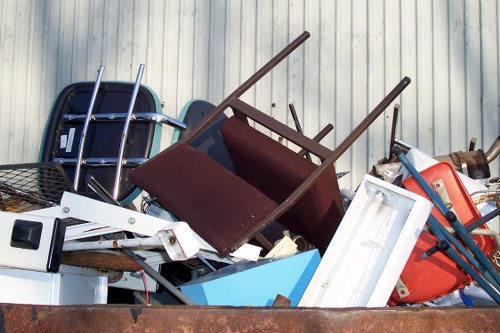
Bulky commercial items need careful handling because they take up space, are awkward to move and can slow down other work if they are left in corridors or storage areas. Our furniture disposal service is suited to office desks, chairs, filing units, reception seating, tables and other business furniture that no longer fits the needs of the premises. The aim is to remove these items cleanly and with as little disruption as possible.
Furniture disposal is often paired with clearance work when a room is being reconfigured, refitted or emptied in stages. In some cases, the most efficient approach is to remove a few larger pieces first so that smaller rubbish can be sorted and loaded more easily afterwards. Where furniture is still assembled, we can work around that; where it has already been dismantled, the collection can be organised as part of a wider waste load.
If you are planning a workplace tidy-up, it helps to identify the large items first and then add the smaller waste around them. That keeps the job focused and makes it easier to choose the right collection. One well-planned clearance is usually simpler than several rushed ones spread across the week.
Office Clearance and Internal Strip-Out Waste
Office clearance usually involves more than a few bags of rubbish. It may include desks, monitors, cabinets, partition elements, chairs, boxes of archived material and general waste left behind after a move, refurbishment or deep reset. Our work is suited to premises that need a careful removal rather than a hurried sweep, especially where access points, lifts or shared corridors need to stay clear for others using the building.
Commercial office waste often benefits from a staged approach. Heavier items can be removed first, followed by bagged waste, loose materials and smaller objects that would otherwise get in the way. If your workspace contains a mix of furniture and general rubbish, grouping similar items together helps the collection run more smoothly. A concise list, or even a brief photograph-based summary, is usually enough to identify the likely scope of the load.
Recycling, Sorting and Responsible Disposal

Commercial waste removal is rarely just about shifting items into a vehicle. Good sorting matters because different materials need different handling, and some waste is better separated before it leaves the site. We support collections where recyclable materials, reusable furniture, cardboard, metal, mixed rubbish and other non-hazardous items need to be grouped sensibly. That makes the overall process more manageable and helps avoid unnecessary mixing of waste types.
Recycling and sustainability is most useful when a business wants to understand how its clearance can be organised with less waste going into the general stream. It is sensible to separate cardboard, metal, clean office items and other materials that are easier to sort. A clear collection plan also helps when there are several waste categories on the same site, because the team can decide what should be moved first and what can be bundled together.
- Separate bulky furniture from loose waste where possible.
- Keep cardboard, metal and general rubbish in different piles if the site layout allows.
- Identify anything that needs extra care because of weight, shape or access.
Pricing Factors and Quotation Details
Commercial waste removal quotes are usually shaped by the amount of material, the kind of items involved, access on site and the time needed to complete the collection. A small bagged load is different from a room full of office furniture, and a ground-floor pickup is different from a collection that involves stairs, tight passages or shared building access. The clearer the description, the easier it is to match the job to the likely effort involved.
Pricing and quotes is the most relevant place to look when you want to understand how a collection may be assessed. It is helpful to mention whether the work is a one-off clearance, a repeat disposal arrangement or part of a move, because that can affect the plan for loading and sorting. Accurate details reduce the chance of confusion later, especially when the waste is spread across more than one area.
For many businesses, the simplest quotation comes from a short outline that covers the main items, access and timing. If you are comparing options, keep the description focused on what needs removing rather than trying to explain every room in the building. Practical detail beats guesswork, particularly when the load contains both furniture and general waste.
About Lambeth
Lambeth is a south London borough on the south bank of the Thames, with a landscape that combines dense residential streets, major transport corridors and a number of historic and cultural landmarks. The borough includes areas such as Brixton, Clapham, Vauxhall, Streatham, Kennington, Norwood and Waterloo, each with its own character and built form. The River Thames forms the borough’s northern edge, while the southern parts rise towards the higher ground shared with nearby parts of inner south London. This mix of riverfront, town centres and neighbourhood streets gives Lambeth a varied urban fabric rather than a single uniform centre. Its history is reflected in older terraces, civic buildings, rail connections and public spaces that sit alongside more recent development. The borough is also known for cultural venues and institutions that draw people across London, including the Southbank area near the river, the Clapham area’s green spaces, and Brixton’s long-established markets and music culture. Lambeth’s parks, commons and open spaces are a notable part of its character too, with places such as Brockwell Park and Clapham Common providing large, well-used green areas. The borough therefore brings together waterways, transport links, high streets and local landmarks in a way that makes it one of the more recognisable parts of inner London.
Household-Style Clearances for Mixed Premises

Some commercial sites need clearance that resembles a property clean-out rather than a standard office collection. That can happen with small flats above shops, staff accommodation, managed premises or mixed-use spaces where furniture, domestic items and general waste have all been left together. In those situations, the work needs a tidy and methodical approach so that items are removed in the right order and the remaining area is left ready for its next use.
Flat clearance and related clearance work can be useful when businesses or landlords are dealing with a compact property that contains a mixture of furniture, bags, soft furnishings and loose contents. Home clearance covers similar kinds of item grouping in a broader setting, while house clearance may suit larger domestic-style clearances where more rooms are involved. These pages are relevant when the load is less like routine office rubbish and more like a complete contents removal.
If you are arranging a mixed clearance, it helps to think in categories: large items, bagged waste, loose contents and anything that needs a more careful lift. That way, the collection can be organised around what is actually on site rather than around a generic label. Clear categories make a practical difference when time on site is limited.
Specialist Item Removal and Specific Waste Types
Some business waste is straightforward, but certain items need their own treatment because of size, material or handling requirements. Fridges, appliances, mattresses, sofas and similar objects are often best separated from general rubbish so that they can be collected in a more appropriate way. Where a workplace, rental property or managed building has accumulated one or more of these items, a targeted removal service can make the clearance much easier to plan.
Fridge and appliance removal is useful when electrical or bulky white goods need to be taken away as distinct items rather than as part of a mixed waste pile. For upholstered or sleep-related items, mattress and sofa disposal gives a clearer fit, because these items are awkward to store and move. Where the waste is concentrated in one location, removing these objects first can create space for the rest of the job.
How to Prepare a Commercial Waste Collection

A good quotation is easier to shape when the waste is described clearly, but the preparation does not need to be complicated. A brief summary of the main items, the level of access and whether anything is particularly heavy or awkward is usually enough to begin. If the waste is in several rooms, a simple room-by-room note can be more helpful than a long explanation, especially when the job contains a mixture of furniture and loose rubbish.
Before collection, it is useful to keep the route clear where possible and decide which items stay and which items are to be removed. If the site has restricted access, shared entrances or narrow corridors, mention that when you ask for a quotation so the collection can be planned sensibly. For a straightforward next step, you can request a quote once you know the main load and the general layout.
If you are ready to move forward, use the most relevant page for the type of waste you have and then ask for a quotation. Contact us when you need the collection arranged and the waste described in practical terms. The aim is to make the process easy to understand, easy to schedule and suitable for the material that needs removing.